

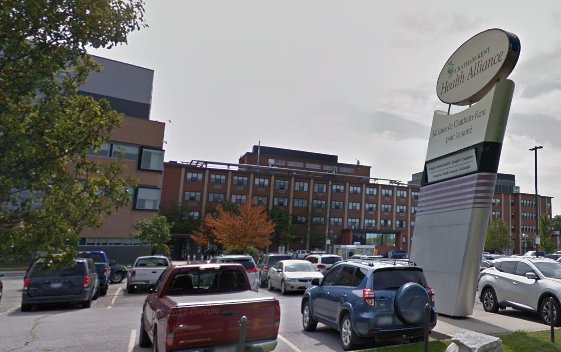

While a recent study attributes government underfunding to rising patient wait times at the Chatham-Kent Health Alliance, the hospital’s top executive says it’s not that simple.
According to “Failure, By Design,” a study from the Canadian Centre for Policy Alternatives, rising hospital costs and government underfunding are undermining timely access to care for patients.
At a recent press conference, Senior Researcher Andrew Longhurst said wait times at CKHA increased 30 per cent in five years since 2020-21, with 90 per cent of patients in the emergency department waiting an average of 24 hours.
However, CKHA President and CEO Adam Topp disagrees with the findings.
“I think to say that wait times are caused by any one item is ignoring the actual complexity in the system,” said Topp.
“Wait times are dependent on your vacancy rate… it is related to how well you can recruit staff, and that means nursing staff, it means respiratory therapists, it means physicians,” he said. “Wait times are also correlated to the availability of long-term care [and] home care. We have 30 patients in the hospital every day that require care that is now hospital care.”
The study points out that Chatham-Kent’s hospital has run budget deficits over the last two years, including an $11.8 million shortfall in 2024-25.
That has since been reduced to a $5-6 million deficit, Topp said.
“Our financial deficit is going down, and our wait times are beginning to come down,” he said. “We’re raising our concerns with government on a regular basis. It’s something even in our strategic plan that we identified that we want to address here at Chatham-Kent Health Alliance because waiting for care is not ideal, and we’re working really hard to make sure we can treat our patients in an environment where they wait as little as possible.”
Topp added that CKHA continues to do everything it can to address wait times with the resources at its disposal, which has led to a reduction in wait times for diagnostic imaging services.
The Ontario government recently invested $1 million to increase Computer Tomography (CT) operational capacity in the hospital’s Diagnostic Imaging Department. The hospital performs around 24,000 CT scans each year.