
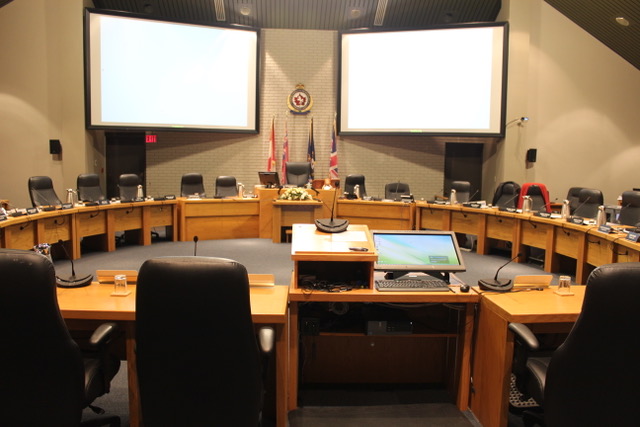
After just two nights of deliberations, members of Chatham-Kent council have given their seal of approval for the 2026 municipal budget update with local residents facing a 4.63% tax increase.
This is down from the initial proposed tax increase of 4.92 per cent the budget committee faced going into deliberations on Tuesday, but higher than the 3.96 per cent where the committee landed after the first round of talks.
The budget results in an annual increase of $172 for the average home.
In the end it was the dust suppression debate which caused the final rate increase.
Councillor Anthony Ceccacci revised his motion from Tuesday night, which saw dust suppression being reinstated in a pilot program of one application with the application being funded from the strategic reserves.
The South Kent representative proposed to increase the application to two, with the cost increase also coming from the strategic reserves.
“I received some comments regarding the dust suppressants, and spoke to some individuals as well,” said Ceccacci. “I really think that we have to look at improving our current system, so I think that if we are getting concerns that one isn’t enough, what will that look like?”
The amended motion passed 13 to 4, with councilors Alysson Storey, Aaron Hall, Melissa Harrigan, and Rhonda Jubenville voting against.
With the committee divided between reinstating and a pilot project, Councillor Michael Bondy proposed bringing back full dust suppression as it had been during the last budget deliberations.
“The reason why we took it out wasn’t that it didn’t work, it was that we were told it didn’t work,” said Bondy. “And we heard loud and clear oh no it works, put it back, leave well enough alone.”
Bondy read a statement he received from officials with the Kent Federation of Agriculture, who said the most effective way to accomplish a level of dust suppression is to do all the roads.
Councillor Aaron Hall agreed and was done with the waffling.
“We made the decision last year to pull this, we quickly brought it back, we are bringing it back now. We heard loud and clear I think form the community,’ said Hall.
“We are making this a pilot project, we are taking out of reserves for a one year thing, we are just punting this to the next council, they are going to make that decision. Based on what we were talking about yesterday, you pull from the reserves to pull down the tax. The next council is essentially going to do this…if we want to keep punting it like this we should fix it and just put it back into base.”
General Manager of Infrastructure and Engineering Services, Edward Soldo, offered this advice when asked whether it was better to try something new or reinstate a previously tested approach.
“We had hundreds of complaints when we had this level of service prior. We had hundreds of complaints when we didn’t have any service,” said Soldo.
“And I can guarantee you we will have hundreds of complaints no matter what option you pick tonight…it’s too many parameters in here in terms of how do we consider this to be successful. And the worst parameter to use in terms of success is the number of complaints.
Bondy’s motion to reinstate dust suppression passed 10 to 7 and added $1.47 million to the budget which amounts to a 0.67 per cent increase.
The budget committee unanimously voted through a motion, focused on confidential wage and labour-related budget items that was brought forth during Tuesday’s closed session. The committee authorized $26,922 in tax-funded wage adjustments, $1,700 in area-rated adjustments, and a one-time draw of $2.04 million from the Employment and Labour Relations Reserve to cover labour-related costs for 2026.
The final budget was ultimately passed by council in a 10 to 7 vote, with councillors Brock McGregor, Ryan Doyle, John Wright, Trevor Thompson, Bondy, Rhonda Jubenville and Anthony Ceccacci voting against.
“I think ultimately we as a council made some really positive financial decisions. We didn’t borrow from reserves to fund base funding so that is a really great practice,” said West Kent councillor Melissa Harrigan.
“We made a difficult decision to put something back into base budget to provide a service that really helps with stability I think for rural residents and community members and give some clarity on that…there are a lot of really positive things the municipality is doing for our community that can be found in this budget while keeping it under a five per cent increase.”